• Skip to primary navigation
  • Skip to main content
  • Skip to primary sidebar

Lots of Helpers

Our family's life in New Zealand

  • Home
  • Our Library
  • Math Freebie
  • Contact Us
  • Legal Policies
    • Disclosure and Disclaimer
    • Privacy Policy
You are here: Home / Archives for Book Review

Book Review

The Girl From the Train—book review

November 13, 2015 by NZ Filbruns 2 Comments

When I read a review of The Girl From the Train on a blog I follow, I was immediately intrigued by the story. Sure enough, it is a fascinating could-have-happened love story.

_225_350_Book.1749.cover

Gretl and her sister Elza were pushed out of a train full of Jewish people on their way to a concentration camp, by their mother and grandmother, who couldn’t fit through the sides of the car. The girls end up living in the house of a Polish family, but after Elza dies, Gretl ends up being rescued by Jakob, a Resistance fighter.

After the war, he sends her to South Africa,where she will have a chance at a better life. Years later, he is forced to flee the Communists in Poland, and ends up in South Africa himself.

Initially, I was disappointed to discover that The Girl From the Train is fiction. I had hoped for a true story, but this did turn out to be very real. It certainly could have happened! Another thing I noticed immediately was that the writing style seemed to be somewhat stilted. Either that improved as the story went on or I got so engrossed in the story that I didn’t notice! When I finished the book and read the author’s biography I understood why it seemed stilted—it was originally written in Afrikaans and recently translated into English. Anyway, the story certainly sucked me in and I had a hard time putting it down, by the time I was a fourth of the way through.

I found the psychological side of the story quite interesting. Gretl, or Grietjie as she was called in South Africa, frequently had nightmares which she couldn’t understand. Until she was willing to be open and honest about her entire life to her adoptive parents, she was never able to find relief. I also appreciated the Christian faith that is a very real and natural part of the story. I could understand Grietjie’s family and their distrust of Catholics, but I also understand how she was able to find Jesus through the work of the Catholic nuns who helped care for her in Poland—God has His people everywhere.

Finally, I appreciated this quote, spoken by Grietjie’s grandfather.

“Grietjie, love is not about excitement and physical desire and attraction. Those things are important, of course. But true love is the core that remains after the infatuation has burned out.”

I received this ebook free from the publisher through the BookLook Bloggers book review bloggers program. I was not required to write a positive review. The opinions I have expressed are my own. –

WARNING: Chapters 2, 4 and 6 each have one or two instances of someone swearing, and beginning in chapter 14 there are a number of times when a kiss is described. Physical relationships never go past kissing, however.


Filed Under: Book Reviews Tagged With: Book Review

Exploring Creation With Zoology 1: Flying Creatures of the Fifth Day–book review

November 1, 2015 by NZ Filbruns 7 Comments

This year, we used Zoology 1. Here is the review I just finished writing of it.

exploring-creation-with-zoology-1

This is the second of Apologia’s elementary science books that we’ve used. We just finished it; last year we went through their Human Anatomy book. Several of my boys liked Flying Creatures of the Fifth Day a lot better than last year’s science. Apparently, birds, bats and insects are much more popular than the human body, among my sons!

I used Flying Creatures with five boys at once this year, ages 15, 13, 11, 9, and 5. I was very pleasantly surprised by how much the 5-year-old learned from this course! At the beginning of the year, he wasn’t remembering much of anything, but by the end of the year he was able to remember a fair amount from each lesson. His dictated narrations were longer and better as the year went on. 

Exploring Creation With Zoology 1: Flying Creatures of the Fifth Day is divided into 14 lessons, each intended to take about two weeks to complete. We averaged a week and a half to two weeks, and that was a very comfortable pace. The first six lessons are about birds, including a lesson about flight which my sons found quite interesting. Lesson 7 is all about bats, lesson 8 is about flying reptiles (extinct), and the remaining six lessons are about insects of all types. Ever since we started learning about insects, my 3-year-old, who often listened in and looked at the beautiful color photos illustrating nearly every page of the textbook, has been bringing me insects and wanting to study them. 

This textbook is anything but dull and dry. The content is presented in an engaging, interesting way, with amazing facts about the various birds and insects sprinkled throughout. I loved going through it, and I just asked my 11-year-old if he had anything to say. He responded, “I loved it!” One thing we especially appreciated was the way God is honored all the way through this course. Before we discovered the elementary Apologia textbooks, we used a lot of Usborne books for science, and frequently I had to tell the boys that something wasn’t true. This especially bothered one of them, who then didn’t know whether to believe anything in the book we were reading. He hasn’t had that problem with Flying Creatures! We’re looking forward to working through Zoology 2 next year.

I purchased the Notebooking Journals to go along with the textbook. For me, they are very valuable. You could easily make your own by following the directions in the textbook at the end of each lesson, but for us it works best to have something preprinted. At the beginning of each lesson, the notebook has a couple of pages on which to take notes or draw pictures. I generally have each boy write a sentence about what he learned in each little section of the lesson as I read it aloud. After we’ve read the entire lesson, we answer the review questions. We don’t use the crossword puzzles for vocabulary practice, because of the dyslexia we have to work with, and we haven’t used the handwriting practice pages, because we had a different handwriting course. We almost always make the mini-books they provide as a final review for each lesson, however. They have been a good way to organize what we learned in the lesson. Each lesson also has a page or two of further activities for investigating the topic of the lesson, and suggested books or DVDs to go along with it. We were able to find a few of the suggested books in the library. 

I am very thankful to have found Apologia and look forward to continuing through their books!


Filed Under: Book Reviews Tagged With: Book Review, Homeschooling, Science

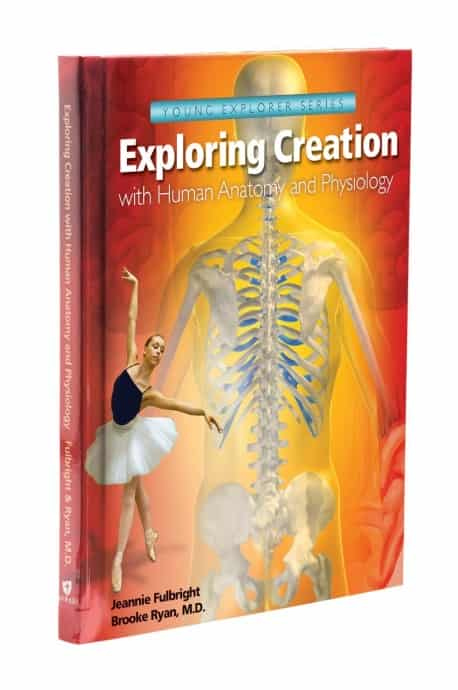
Exploring Creation With Human Anatomy and Physiology–book review

October 30, 2015 by NZ Filbruns Leave a Comment

Sometime last year, I wrote a post about this book, but I decided to share the review I just finished writing of it here anyway. I love Apologia!

exploring-creation-with-human-anatomy-and-physiology

For about 10 years, we used Sonlight Curriculum for our science. It was all right, but we didn’t love it. Two years ago, I discovered Apologia’s Young Explorer Series and was able to get some of the textbooks used, to take a good look at them. One look was all it took to convince me that these books were a better fit for our family than what we had been doing.

The first Apologia elementary science textbook we used was Exploring Science With Human Anatomy and Physiology. Looking back, I’m not sure I’d recommend starting with that one. It goes into a lot of depth and is more advanced than some of the other books. I used it with four of my boys, ages 14, 12, 10, and 8. The 10-year-old loved it; the 12-year-old had decided before we ever started that he would hate it, and couldn’t back down. I loved it! I learned a lot, myself. For example, I just opened the book at random and found where it talked about growth plates. Your long bones, such as in your arms and legs, have growth plates close to the end, where new bone is added to make you grow. Of course, once you are full-grown, these growth plates fill in with solid bone. If you are injured at a growth plate when you are young, that bone may stop growing and you may end up with one leg or arm shorter than the other! Right after we read that part of the lesson, we ate chicken for dinner, and one of my sons discovered a growth plate in a leg bone. Science at the dinner table!

Each of the 14 lessons in the book has around 15 pages of engagingly-written information about the topic for that chapter—bones or cells or respiratory system, etc—and then a few pages of activities to help cement the information in the children’s minds. The author recommends making a notebook to go along with the textbook, and taking notes as each chapter is read. There are also review questions in the last section of each lesson and an experiment to illustrate a point from the lesson. Throughout the book, you will be given instructions in making a “personal person”–a picture of a person, to which are added more and more layers as you go through the book. Each layer will be a different body system, such as the skeleton, the circulatory system, the respiratory system, and so on. Each lesson should take about two weeks to work through.

To go along with the textbook, Apologia offers Notebooking Journals. They have one for older children and one for grades 1-2. I used them to go along with this course, and found them to be very useful. At the beginning of each lesson, there are a couple of pages on which to take notes or draw pictures of what is being taught. I always read the textbook aloud, and at the end of each section (1/2-2 pages) I have each of the children write a sentence about what I read. After we have finished the reading for the lesson, we answer the review questions, which are in the notebook. There are also crossword puzzles for the vocabulary words in each lesson, which we don’t use because they are too much for my dyslexic sons, and handwriting pages with a Scripture verse that goes along with the topic of the lesson. Then, there is a page on which to glue a mini-book about the topic of the lesson (the pieces to put together for the mini-book are in the back of the notebook). The children write what they have learned from the lesson in the mini-book. There are also a few pages of suggestions for further study, such as books or DVDs, and other activities and investigations you can do. The Junior Notebooking Journal contains most of these features, with a few changes to make them simpler for younger children. Instead of the crossword puzzle, there is usually a cut-and-paste activity for vocabulary, and there are coloring pictures at the beginning of each lesson.

One of my favorite aspects of Apologia’s Science is the way God is honored! For the past several years, one of my sons had been asking me if this or that was true, in the Usborne books we were using. I had to tell him, every so often, that no, this part is not true. In Exploring Creation With Human Anatomy and Physiology, I never had to say that! Over and over throughout the book, the author points to God’s wonderful design for our bodies. I can’t recommend this book highly enough! Oh, one more thing I liked. The last chapter is titled “Growth and Development.” Even though it talks about the development of the embryo and growth of a baby in the womb, and about genetics, the author does not discuss how a baby is made. There was absolutely nothing in that chapter that I did not want to read to my young boys.

Filed Under: Book Reviews Tagged With: Book Review, Homeschooling, Science

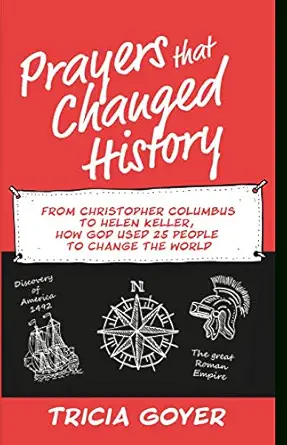
Prayers That Changed History–a book review

October 19, 2015 by NZ Filbruns Leave a Comment

I’ve recently signed up for a couple of programs in which I can get free books in exchange for reviewing them. I’m primarily reviewing them for Esther’s website (www.ignitelit.com), but occasionally I’ll be posting a review on this blog as well because some of the publishers require that. So, read it if you’re interested, skip it if you’re not!

Prayers That Changed History gives us a unique look at history. Tricia Goyer, a homeschooling mom, wrote the book as an encouragement to all of us, and especially children, to pray. We never know the impact our prayers might have on other people and even the course of history. Most of the people mentioned are quite familiar—who hasn’t heard of George Mueller or Amy Carmichael? Some are more obscure, though; do you know what Robert Raikes did for mankind?

Each of the 25 chapters begins with a picture of the person highlighted, and the dates of that person’s life, and then you get to read a story from the person’s life, describing a particular time that he/she prayed specifically for something. Then, the author gives “Something to Think About”–application to our lives today. Following this is the result in history of the person’s prayer, and then a story in the Bible that is somewhat similar to the story just told. Following this is more application and a final statement to cement the lesson.

I appreciated this look at history. Most of the stories were already quite familiar, but I had never read the one Tricia Goyer told about Amy Carmichael. It was an amazing testimony of the power of prayer!

Prayers That Changed History would be a wonderful resource to accompany a study of Christians throughout history, as well as a good devotional. I would recommend having middle school or high school children read it, maybe a chapter a week.

I received this book free from the publisher through the BookLook.com® book review bloggers program. I was not required to write a positive review. The opinions I have expressed are my own.


Filed Under: Book Reviews Tagged With: Book Review

Science This Year

March 20, 2014 by NZ Filbruns Leave a Comment

I’m excited about what we’re using for Science this year for the boys. Until now, we’ve always used Sonlight Curriculum’s Science, which is a variety of subjects each year and mostly Usborne books. They have activity sheets to go along with the books, and the curriculum is all right as far as it goes. I was starting to feel, though, that we were just scratching the surface of all the different subjects and never digging in deeper, and the boys were getting very bored with it, groaning when it was time to do science. That’s not what we want! Well, sometime around the first of the year I noticed some science books come up on an email list I get, on which homeschoolers around New Zealand can buy and sell books they don’t need anymore. These books were published by Apologia Press, and I knew how much my Mom liked the high school level books they put out. Esther used one last year, and loved it–I never heard her talk so much about what she was learning as with that book! So, I took a closer look on the Apologia website at these books, for elementary students. I liked what I saw! They have six books for younger children, covering Astronomy, Botany, Zoology (three years: birds, fish, land animals), and Human Anatomy. There is a hard cover textbook for each level/subjects, and a notebooking journal to go along with it, with lesson plans. There are actually two notebooks for each textbook, one for older children and one for younger. I was able to get a couple of the textbooks, and notebooks for the Human Anatomy book, from the email list, so we could take a good look. Wow! I liked them immediately! The boys picked up the one about fish right away and were fascinated; one boy even started doing a project from it. I decided, though, that since we had the notebooks for Human Anatomy that we’d do that one this year, and ordered more notebooks so each boy will have one. One of the boys is still proclaiming loudly that the book is boring, and one is ambivalent, but the other two are enthusiastic–and I love it, too! This book glorifies God as Creator and designer all the way through, and shows clearly how wonderfully we are designed. So far, we’ve studied cells, and the boys each got to draw a diagram of a cell (not a simple thing, by the way!). Now, we’re studying bones and the skeleton, and when we happened to eat chicken the day we learned about growth plates we actually found a growth plate on a chicken bone! The notebooking journals provide a great way to write down what they’ve learned, and draw pictures. Some pages have questions to answer or activities to do; we’ll be building a “personal person” for each boy as we go, with overlays to glue onto a picture, showing the skeleton, muscular system, nervous system, etc. I am so thankful to have stumbled onto this book!

This is how we do science–all of us sit on the floor. I read aloud from the textbook, and then we work on filling in the notebooks.

Filed Under: Activities at Home, Book Reviews Tagged With: Book Review, Homeschooling

  • « Go to Previous Page
  • Page 1
  • Interim pages omitted …
  • Page 23
  • Page 24
  • Page 25

Primary Sidebar

  • RSS Feed
  • Facebook
  • YouTube
  • Goodreads

Recent Posts

  • April 2026 Photos
  • New in the Library! May 2026
  • March 2026 Photos
  • Recovery
  • Book Review–Blaze of Honor

Archives

Disclosure

Some links on this site are affiliate links.

Subscribe to the Blog

/* real people should not fill this in and expect good things - do not remove this or risk form bot signups */

Intuit Mailchimp

The Family:


Dad and Mom (Gayle and Emma)

Girl #1, Esther, my right hand

Boy #1, Seth (Mr. Handyman)

Boy #2, Simon (Mr. Inventor)

Boy #3, Mr. Intellectual

Boy #4, Mr. Diligence

Boy #5, Mr. Sweetie

Boy #6, Mr. Imagination

Girl #2, Little Miss

Girl #3, Miss Joy

Book Reviews Website

IgniteLit

COPYRIGHT © 2026 · TWENTY SEVEN PRO ON GENESIS FRAMEWORK · DISCLOSURE & DISCLAIMER · PRIVACY POLICY