Sometime last year, I wrote a post about this book, but I decided to share the review I just finished writing of it here anyway. I love Apologia!
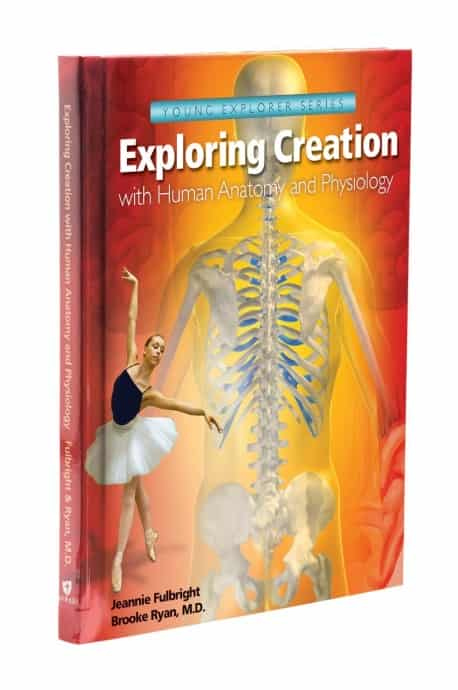
For about 10 years, we used Sonlight Curriculum for our science. It was all right, but we didn’t love it. Two years ago, I discovered Apologia’s Young Explorer Series and was able to get some of the textbooks used, to take a good look at them. One look was all it took to convince me that these books were a better fit for our family than what we had been doing.
The first Apologia elementary science textbook we used was Exploring Science With Human Anatomy and Physiology. Looking back, I’m not sure I’d recommend starting with that one. It goes into a lot of depth and is more advanced than some of the other books. I used it with four of my boys, ages 14, 12, 10, and 8. The 10-year-old loved it; the 12-year-old had decided before we ever started that he would hate it, and couldn’t back down. I loved it! I learned a lot, myself. For example, I just opened the book at random and found where it talked about growth plates. Your long bones, such as in your arms and legs, have growth plates close to the end, where new bone is added to make you grow. Of course, once you are full-grown, these growth plates fill in with solid bone. If you are injured at a growth plate when you are young, that bone may stop growing and you may end up with one leg or arm shorter than the other! Right after we read that part of the lesson, we ate chicken for dinner, and one of my sons discovered a growth plate in a leg bone. Science at the dinner table!
Each of the 14 lessons in the book has around 15 pages of engagingly-written information about the topic for that chapter—bones or cells or respiratory system, etc—and then a few pages of activities to help cement the information in the children’s minds. The author recommends making a notebook to go along with the textbook, and taking notes as each chapter is read. There are also review questions in the last section of each lesson and an experiment to illustrate a point from the lesson. Throughout the book, you will be given instructions in making a “personal person”–a picture of a person, to which are added more and more layers as you go through the book. Each layer will be a different body system, such as the skeleton, the circulatory system, the respiratory system, and so on. Each lesson should take about two weeks to work through.
To go along with the textbook, Apologia offers Notebooking Journals. They have one for older children and one for grades 1-2. I used them to go along with this course, and found them to be very useful. At the beginning of each lesson, there are a couple of pages on which to take notes or draw pictures of what is being taught. I always read the textbook aloud, and at the end of each section (1/2-2 pages) I have each of the children write a sentence about what I read. After we have finished the reading for the lesson, we answer the review questions, which are in the notebook. There are also crossword puzzles for the vocabulary words in each lesson, which we don’t use because they are too much for my dyslexic sons, and handwriting pages with a Scripture verse that goes along with the topic of the lesson. Then, there is a page on which to glue a mini-book about the topic of the lesson (the pieces to put together for the mini-book are in the back of the notebook). The children write what they have learned from the lesson in the mini-book. There are also a few pages of suggestions for further study, such as books or DVDs, and other activities and investigations you can do. The Junior Notebooking Journal contains most of these features, with a few changes to make them simpler for younger children. Instead of the crossword puzzle, there is usually a cut-and-paste activity for vocabulary, and there are coloring pictures at the beginning of each lesson.
One of my favorite aspects of Apologia’s Science is the way God is honored! For the past several years, one of my sons had been asking me if this or that was true, in the Usborne books we were using. I had to tell him, every so often, that no, this part is not true. In Exploring Creation With Human Anatomy and Physiology, I never had to say that! Over and over throughout the book, the author points to God’s wonderful design for our bodies. I can’t recommend this book highly enough! Oh, one more thing I liked. The last chapter is titled “Growth and Development.” Even though it talks about the development of the embryo and growth of a baby in the womb, and about genetics, the author does not discuss how a baby is made. There was absolutely nothing in that chapter that I did not want to read to my young boys.

Leave a Comment